

In Vitro Trials
In Vitro Bio Assay Results on Banana Diseases Moko &TR1 at ESPOL Tech

TECHNICAL REPORT
CLIENT INFORMATION
Client: Jack Bracewell @ Salveo
Date: 20/12/2024
Company: SALVEO AGRO
DETAILS OF THE ANALYZED SAMPLE
Service ID: FT-2024-073
Date of receipt: 11/11/2024
Sample name:
1.
Textus Matrix -
2. Textus Matrix -1
Sample Type: Liquid biocidal products containing #2 and #1 formula.
Number of samples: 2
Packaging: Plastic container
Analysis:
1. In vitro evaluation of the biocidal effect of Textus Matrix #1 and Textus Matrix #2 on Ralstonia solanacearum phylotype II and Fusarium oxysporum f.sp. cubense race 1 (VCG0120).
Start date: 20/11/2024
End date:11/12/2024
Methods:
. The solutions were tested against Ralstonia solanacearum using serial dilutions (1–500 ppm) to determine MIC and MBC via spectrophotometry and solid media. For Fusarium oxysporum f. sp. cubense, the plate dilution method assessed radial growth inhibition over 9 days with 10
replicates per treatment.
METHODOLOGY
a) Evaluation of Textus Matrix products against Ralstonia solanacearum
Serial dilutions of two solutions were prepared at concentrations of 500 ppm, 250 ppm, 100 ppm, 50 ppm, 10 ppm, 5 ppm, and 1 ppm. A standardized sensitivity protocol (Servicio Antimicrobianos, 2012; Malbrán, 2001) was then applied to assess the biocidal activity of these products against R. solanacearum using 96-well flat-bottom plates. The inhibition of R. solanacearum growth was measured spectrophotometrically at an absorbance of 600 nm after 48 hours of incubation. Additionally, the product dilutions were plated on Petri dishes containing solid culture medium. The Minimum Inhibitory Concentration (MIC) and Minimum Bactericidal Concentration (MBC) were subsequently determined.
b) Evaluation of Textus Matrix products against Fusarium oxysporum f. sp. cubense race 1 - VCG0120
The plate dilution method described by Irkin and Korukluoglu (2007) was employed to evaluate the effect of the aforementioned concentrations on the radial growth of F. oxysporum over a 9-day exposure period. Each treatment was replicated 10 times using a completely randomized design (CRD). Potato Dextrose Agar was used as the negative control, while quaternary ammonium served as the positive control.
Statistical analyses
All data sets were assessed for normality. For nonparametric data, the Kruskal-Wallis test was performed, followed by Dunn's test for pairwise comparisons. Comparative analyses were conducted at a 95% significance level (α=0.05). GLM models were also created for comparative purposes. Statistical analyses and visualizations were carried out using R software. LD50 values were calculated using the online LD50
calculator.
RESULTS
Two products, Textus Matrix #1 and Textus Matrix #2, were evaluated for their effectiveness against Ralstonia solanacearum (causal agent of Moko disease) and Fusarium oxysporum f. sp. cubense race 1 (causal agent of Fusarium wilt of banana).
Both products exhibited inhibitory effects on the growth of R. solanacearum. However, Textus Matrix #1 demonstrated superior efficacy, achieving a Minimum Inhibitory Concentration (MIC) and Minimum Bactericidal Concentration (MBC) of 10 ppm, compared to 50 ppm and 100 ppm, respectively, for Textus Matrix #2.
The bactericidal effect was confirmed by culturing the bacteria on solid media following exposure to varying concentrations of both formulations (Figures 1-4).
Both products also inhibited the mycelial growth of F. oxysporum f. sp. cubense (Foc). Similar to the bacterial results, the first-based formulation was significantly (?<0.05) more effective at lower doses compared to the second-based formulation (Fig. 5). Textus Matrix #1 caused an average 40.1% inhibition, with a range of action from 3.9% to 87.7%, whereas Textus Matrix #2 achieved an average 16.2% inhibition, with a range from 3.8% to 100%. For the #1 formulation, mycelial growth decreased progressively with significant inhibition (?<0.05) observed starting at T3 (10 ppm).
At higher concentrations, mycelial growth was nearly suppressed, demonstrating the high efficacy of #1 formulation. In contrast, the #2 formulation showed only minor reductions in mycelial growth at lower concentrations (Fig.6-lower panel), with significant inhibition (?<0.05) starting at T6 (250 ppm). Complete inhibition of growth was observed at 500 ppm. The LD50 (lethal dose to achieve 50% inhibition) was 124.5 ppm for Textus Matrix #1 (Fig. 7), compared to 281.4 ppm for Textus Matrix #2 (Fig. 8).
The full report is available after an NDA is signed.
In Vitro Trials
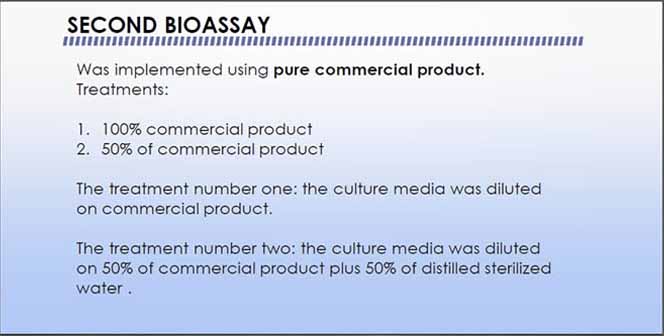
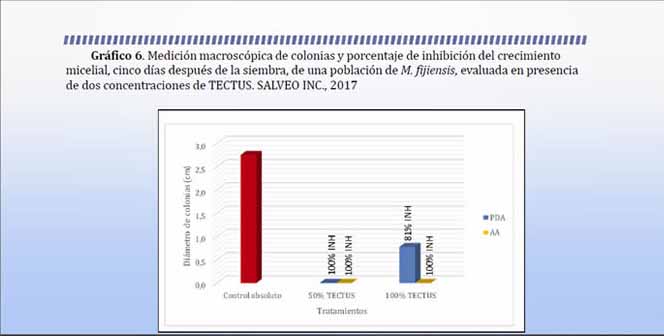
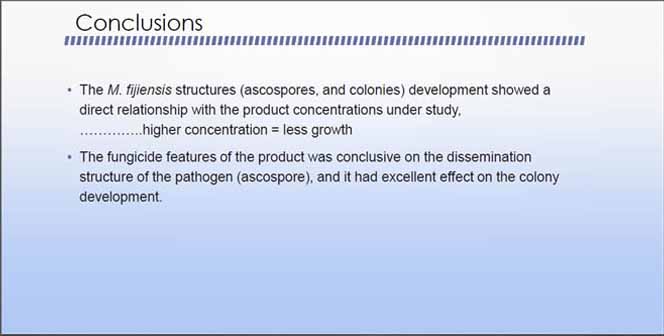
Salveo has and continues to conduct in vitro tests (plant clinical trials) to prove Tectus Matrix® efficacy to mitigate, control, and kill plant fungus. Third Party consultant Agronomist, Dra. Maria Isabel Jiménez, PhD has made the In Vitro tests at the AgroLab in Duran, Ecuador on Tectus Matrix® on many strains of Sigatoka Negra. The lab results showed full control even at low concentrations of Tectus Matrix®.
In Vitro Bio Assay Results on Bananas
In Vitro Assay – Sigatoka Negra (Bananas)
In Vitro Assay – Positive Results (Bananas)
In Vitro Assay – Conclusions (Bananas)

GET IN TOUCH WITH US
for more information contact us....